
Waste Heat With a Paycheck: Running 440 TH/s Through a Cold Room
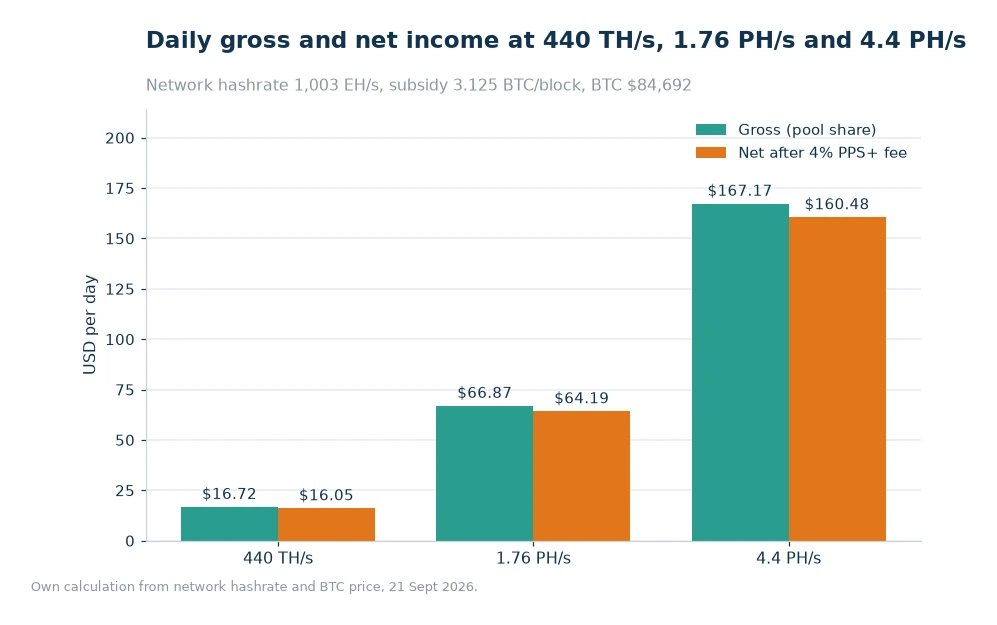
Every watt a miner draws leaves the case as heat, which makes the machine an electric heater that also earns coins. At 440 TH/s and 20 J/TH the unit draws 8,800 watts, or 211.2 kWh a day. The same machine produces 0.00019739 BTC a day, worth $16.72 gross at $84,692 and $16.05 after the listed 4% on the block-reward component, so the heat is not free but it is far from wasted.
Key takeaways
- 8,800 W of electrical draw becomes roughly 8,800 W of heat, day and night.
- 440 TH/s earns 0.00019739 BTC a day, or $16.05 net after the listed 4%.
- A cold-climate miner can offset part of the power bill by displacing resistive heating.
- Summer is the constraint: the same heat that warms a workshop in January has to leave in July.
The machine is a heater first
Almost all of the electricity a mining ASIC consumes is converted to heat rather than to computation in any thermodynamic sense. The fans move that heat out of the case, and the room absorbs it. This is not a byproduct to be managed; it is the physical result of the work, and it arrives at a constant rate regardless of what the coins are worth.
That constancy is what makes the machine useful as a heat source. A space heater switches on and off with a thermostat, wasting capacity most of the day. A miner runs continuously, so a room reaches a stable temperature and stays there. The awkward part is that you cannot turn the heat down without turning off the income, and you cannot turn the income up without adding heat.
Framed that way, the economics change shape. In a building that already spends money on electric heating, a miner's power bill is partly a heating bill that was going to be paid anyway. In a building heated by gas or a heat pump, the comparison is less favorable, and the heat is closer to a disposal problem.
Getting 8.8 kW out of one room
A closed interior room with a single doorway cannot shed 8.8 kW by opening a window. Air has to move, and it has to move in a controlled direction: cool air in at floor level, hot air out near the ceiling, with the path short and unobstructed. A ducted fan moving a few hundred cubic feet per minute is usually enough for one unit, but the duct has to discharge somewhere that will not simply feed the air back in.
Noise is the other constraint, and it is the one that decides whether the machine can live indoors. A single ASIC at full fan speed is louder than a vacuum cleaner. Ducting the exhaust reduces the sound in the room but does not remove it, and a length of flexible duct with a bend or two attenuates more than a straight run.
If the room also contains a person for eight hours a day, the design target changes. Comfortable occupancy is a much lower heat load than equipment tolerance, and the machine will happily run at temperatures a human finds unbearable. Decide which of the two the space is for before installing anything.
| Measure | Value | What it means |
|---|---|---|
| Electrical draw | 8.8 kW | 440 TH/s × 20 J/TH |
| Heat rejected | About 8.8 kW | Roughly the full draw, continuously |
| Daily energy | 211.2 kWh | 8.8 kW × 24 hours |
| Monthly energy | 6,336 kWh | 211.2 kWh × 30 days |
| Heating displaced at $0.06/kWh | Up to $380.16 | If resistive heat would have used the same energy |
Worked example
Compare the coin income with the value of the heat, using the same tariff for both sides.
- Share of the network held by the unit: 440 ÷ 1,003,107,267 = 4.38637e-7.
- Multiply by the 450 BTC issued daily: 4.38637e-7 × 450 = 0.00019739 BTC.
- Gross dollars: 0.00019739 × 84,692 = $16.72.
- Leave out the 4% listed on the reward portion: 16.72 × 0.96 = $16.05.
- Daily power at $0.06/kWh: 211.2 × 0.06 = $12.67.
- Daily margin before hardware: $16.05 − $12.67 = $3.38.
- If the heat displaces $12.67 of resistive heating, the effective daily cost of running the machine falls close to zero, which is the entire argument for indoor mining in a cold climate.
That last step is an assumption, not a guarantee. It holds only if the building would otherwise have paid for the same kilowatt-hours of heat, and only in the months when heating is needed. In a mild spring, the displacement is worth nothing and the machine is simply a cost.
The summer problem arrives on schedule
The same 8.8 kW that keeps a workshop at 18 °C in January pushes it past 35 °C in July, when the outdoor air is already warm and the duct is pulling from a hot loft. Fan curves climb, the machine throttles, and the hashrate falls exactly when the cooling system is working hardest.
There are only three honest responses. Move the exhaust outside and accept the noise, add mechanical cooling and pay for it, or shut the machine down for the hottest weeks. Each has a cost, and the cost should be in the plan before the first summer rather than discovered during it.
Shutting down is not a failure. A unit that runs nine months a year at a good margin can beat one that runs twelve months at a negative one, especially if the summer months are when the tariff peaks. Model the shutdown as a scheduled event with a date, not as an emergency.
The ViaBTC App puts a temperature reading beside the hashrate, which is the pair to watch in a room that runs warm.
Where the heat can go
The simplest destination is a workshop or garage that would otherwise be heated. The next is a domestic hot-water preheater, which needs a heat exchanger and a plumber and rarely pays back quickly. The most ambitious is a greenhouse or drying room, where continuous low-grade heat has real value and the noise matters less.
Each option adds a failure mode. A duct that leaks into a wall cavity is worse than no duct at all, and a heat exchanger that fouls silently will quietly reduce airflow until the machine throttles. Inspect the path, not just the temperature reading.
For a miner planning a larger installation, the Mining Farms listings show how dedicated sites handle the same physics at scale, usually with a purpose-built airflow design rather than a converted room. It is worth seeing one before spending on ducting at home.
At 1.76 PH/s the same calculation scales linearly: 35.2 kW of heat, 0.00078963 BTC a day, $64.19 net. At 4.4 PH/s the heat load reaches 88 kW, which is no longer a room problem but a building problem, and the ViaBTC Bitcoin Mining account view becomes the least of the engineering.
Frequently asked questions
How much heat does a 440 TH/s miner produce?
At 20 J/TH it draws 8.8 kW and releases almost all of that as heat, which is about 211.2 kWh of thermal energy a day, continuously.
Can mining heat a house in winter?
It can displace part of a resistive heating bill, but only in rooms where the airflow reaches and only in months when heat is needed; the value disappears entirely in summer.
Does cold weather improve mining revenue?
No. Revenue depends on hashrate and network difficulty, while cold air only helps the machine hold its rated speed instead of throttling.
Design the airflow before the rig arrives
Sketch the path on paper: where the cool air enters, where the hot air leaves, and what is on the other side of the wall. Then measure the room's temperature on a warm day with nothing running, because that baseline tells you how much margin the building already has. A room that reaches 28 °C in June has no business hosting 8.8 kW in July.
Only after the path exists should the machine be ordered. The Profit Calculator will price the coins; the ducting, the fan and the electrician are the other half of the project.
Sources: ViaBTC farms, calculator and account pages for hosting practice and revenue inputs[1]. Thermal figures assume 20 J/TH; coin and network inputs came from 21 Sept 2026 readings (1,003 EH/s, 132.76 T, 3.125 BTC subsidy, 144 blocks, $84,692). Published 24 Oct 2026.