
Custom Stainless Steel Jewelry for Everyday Wear
Everyday wear is a spec, not a mood. A piece sold as something a customer never takes off has to survive water, sweat, abrasion and skin contact — which is why the wear-testing conversation starts with the metal and the minimum, not the price. Stainless steel at 100–150 pcs by style and a 25–35 day sampling window are the two numbers that shape a private label line built for daily use.

Key takeaways
- Stainless steel is the published base metal for pieces worn in water; minimum 100–150 pcs by style.
- PVD vacuum plating finishes steel, while silver and brass take multi-layer electroplating with anti-tarnish e-coating.
- Master sampling takes 25–35 days and covers five named bench operations.
- Packaging is customisable from logo tags to barcode labels, which is what makes a piece retail-ready.
Why daily wear narrows the material list
Three failure modes show up on a piece that never comes off: the finish breaks down, the metal reacts with sweat, and the geometry digs in. Stainless steel answers the first two because the corrosion resistance is in the alloy rather than in a coating, and because PVD vacuum plating deposits its colour instead of growing it out of a bath. On the third point, nothing but a physical sample will tell you whether a 4 mm band is comfortable at the wrist.
Silver and brass are still valid choices for a daily-wear line, but they carry a different care story. Silver takes an anti-tarnish e-coating, and brass is a plated base metal, so both want the customer to understand that a cloth is part of owning the piece. A brand that sells daily wear usually splits the range: steel for the pieces that stay on, plated and precious metals for the pieces that go on with an outfit.
Skin contact deserves its own line on the brief. REACH compliance covers lead, cadmium and nickel, and nickel is the restriction retailers raise most often on pieces meant to be worn continuously. Name the destination market in the first message, because the documentation request follows from the market rather than from the design. Stainless steel is the usual answer for that brief, and the anti-tarnish e-coating on silver and brass puts an extra layer between the metal and the skin as well.
Everyday wear has two grades behind it. 316L is the one to specify when the piece has to be shower-safe, sweatproof and swim-proof: its 2–3% molybdenum content drives the corrosion resistance, and it is published as medical-grade hypoallergenic, which answers the skin-contact question before it is asked. 304 suits water-resistant daily wear, is nickel and lead safe, and takes reliable commercial vacuum plating — a reasonable fit for large wholesale runs and fast-fashion drops where unit cost decides the line.
Where the minimum fits into a wear-first range
The published minimums are 925 silver, artisan eco-brass and stainless work at 100–150 pcs. A private label stainless steel jewelry programme therefore starts at the top of the ladder, and it is worth understanding why: steel is the hardest of the three to form and finish, and a short run cannot absorb the setup across enough units.
The practical reading is that a steel line rewards simplicity. One silhouette in one finish inside that band is a cheaper experiment than four variants at 30 pieces each, and it produces a cleaner sell-through signal. The MOQ is quoted per design and per style, so the entry point for a two-piece collection in steel is 200 to 300 units rather than 100.
What the sample has to answer before bulk
| Stage | Published figure | What it settles for daily wear |
|---|---|---|
| 3D CAD modelling | Under 48 hours | Thickness, weight and clasp position |
| Master physical sampling | 25–35 days | How the piece survives a week of real wear |
| Mass production | 3–4 weeks | Restock intervals for the best sellers |
| MOQ | 100–150 pcs by style for steel | Depth of the first commitment |
| Final quality control | 100% inspected | Nothing leaves with an open clasp or a burr |
A sample request should say how the piece will be worn. A bracelet that stays on through a shower needs a different clasp decision from a pendant that comes off at night, and that difference is least costly to settle on screen. Because the CAD stage returns in under 48 hours, weight and geometry can be adjusted before the 25–35 day sample window is even opened.
Worked example: how five bench operations fill the sample window
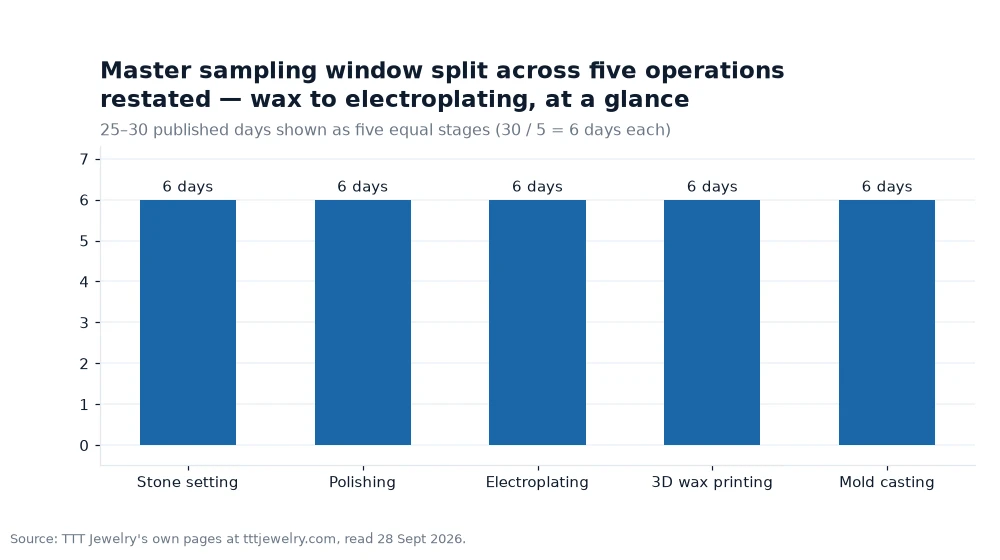
The published sampling sequence names five operations: 3D wax printing, precision mold casting, stone setting, polishing and custom electroplating. Spread the middle of the published window across them and 30 days ÷ 5 operations = 6 days per operation, which is the figure charted here. At the fast end, 25 ÷ 5 = 5 days each; at the slow end, 35 ÷ 5 = 7. Treat six as the working assumption and seven as the honest worst case.
That is a strictly sequential reading, and it is the assumption to plan on. It also explains why small changes between operations are cheap and late changes are not: adding a second polishing pass costs six days, not an afternoon. For a private label line, the useful habit is to batch all the geometry and finish decisions into one round of feedback rather than three.
Making a wear piece retail-ready
Packaging decides whether a daily-wear piece sells as a considered product or as a loose item in a tray. The published options are backing cards for display, foil-stamped gift boxes, velvet/microfiber pouches, logo tags and bar-coded labelling — all available on a private label order, and all specified before the QC pass rather than after it.
The rest of the retail readiness sits in the mark. A 316L hallmark tells the customer what the metal is, a laser-engraved logo makes it yours, and a barcode label makes it sellable in a shop. None of the three adds a production stage to the eight-step process; they are decisions taken at sampling and applied at packing.
Frequently asked questions
Can a steel bracelet be worn in the shower?
Yes. The resistance sits in the alloy and the finish is PVD vacuum plating, so water and soap do not start a corrosion reaction the way they would on a plated brass piece.
How many pieces do I need for a first private label run?
100–150 pieces per style for stainless steel, 100 for artisan eco-brass and 50 per design for 925 sterling silver, quoted per design and per material.
Is the design exclusive to my brand?
Yes. A 100% NDA covers the project, and moulds, CAD files and the collection itself stay exclusive rather than being resold or shown to other buyers.
Building a wear-first range without over-buying
Start with the two decisions that cannot be changed cheaply — metal and geometry — then let colour follow. Steel is the material that survives the wear test, and the eight-step process means the finish is one operation inside a documented route rather than a separate project. To line up the paperwork for a first order, the OEM and ODM comparison explains which route fits a brand arriving with drawings and which fits one arriving with a concept, and the wholesale ordering notes cover how minimums work across a collection.
The list this piece builds on — the 100–150 piece stainless minimum (by style), the shower-safe and swim-safe claim plus the 25–35 day custom sample window — is listed at the client's own website at tttjewelry.com (read 28 Sept 2026). The unit conversions are my own, not the site's[1].