
Car and Air-Care Fragrance: How to Evaluate a Supplier Before You Brief
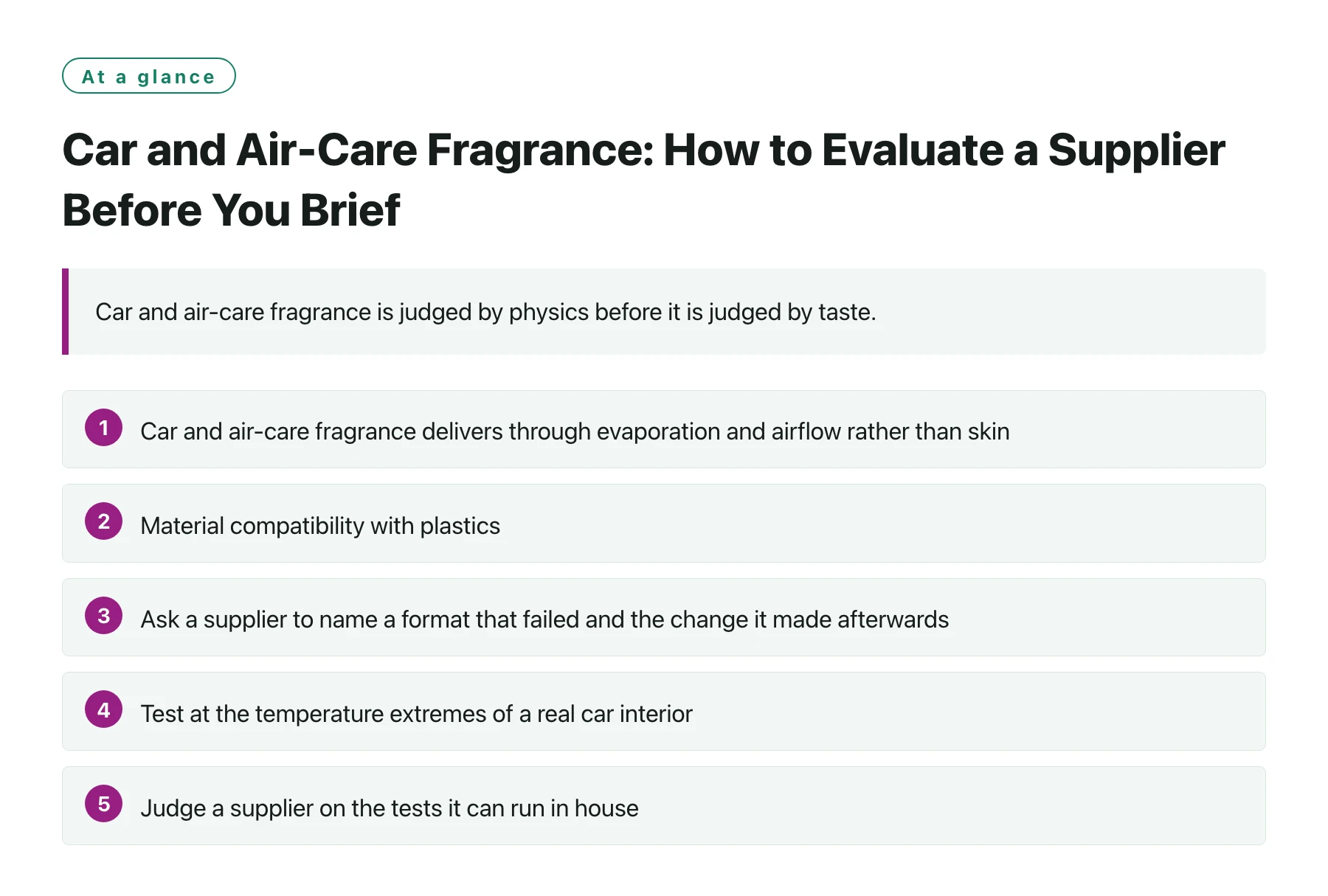
Car and air-care fragrance is judged by physics before it is judged by taste. The scent has to leave a substrate, survive a hot car interior, and land in a small cabin without becoming oppressive, and a supplier that cannot describe how it tests those three things will not deliver a format that works. For a procurement team the practical test is not whether the factory makes air care, but whether it can explain where a previous format failed and what it changed. Ask that question before you brief, and the shortlist usually shrinks by half.
Key takeaways
- Car and air-care fragrance delivers through evaporation and airflow rather than skin, so performance depends on the substrate and the temperature range, not only on the formula.
- Material compatibility with plastics, rubber, coatings and adhesives is the single most common hidden failure in these formats.
- Ask a supplier to name a format that failed and the change it made afterwards; a useful answer is specific and slightly uncomfortable.
- Test at the temperature extremes of a real car interior, because a format that behaves well in a meeting room may collapse on a dashboard.
- Judge a supplier on the tests it can run in house, and expect the rest to be sent to a laboratory with a lead time attached.
Procurement teams that buy fine fragrance and air care from the same factory often assume the difference is a matter of concentration. It is a matter of delivery. A perfume on skin sits in a warm, moving, slightly acidic environment and is evaluated over hours. A car scent sits on a plastic clip near glass, in a space that can get very hot and then very cold, and is evaluated the moment a door opens.
This article is written from the procurement side, for a niche house adding a car or air-care format to a range it already sells. It assumes you have a supplier or two in mind and need a defensible way to judge them before you write the brief.
What you are really buying in an air-care format
In a car or air-care product the fragrance is one component of a delivery system. The system includes the carrier, the reservoir, the membrane or wick that meters the release, the housing, and the airflow that carries the scent into the space. A supplier that talks only about the fragrance has answered a third of the question.
The consequence for evaluation is that the interesting evidence is physical. Can the factory describe how it measures release rate over time, in the actual housing, at two or three temperatures? Does it check the reservoir for leakage after thermal cycling? Has it seen a housing crack, and does it know which materials caused it? These are the answers that separate a supplier who has shipped air care at volume from one who has compounded scent for it.
The scent brief itself tends to follow the format rather than lead it. Fresh, clean accords such as aquatic notes read as appropriate in a vehicle or a small room, while heavy or sweet compositions become oppressive when the same air is recycled for weeks. That is a brief decision, and it is much cheaper to make before sampling than after.
There is also a regulatory layer that procurement teams tend to meet late. Fragrance materials carry use restrictions that vary by product category, so the restriction set for a car interior product is not automatically the same as the set for a body spray [1]. A supplier used to fine fragrance should be able to say which category it is applying and why, and it should be able to show the reasoning rather than the assertion.
If your niche house is expanding from perfume into home and vehicle formats, the fastest way to judge a partner is to see whether it treats this as a formulation question or a systems question. A manufacturer that assembles the whole delivery system under one roof usually answers faster, and this Chinese perfume manufacturer is the kind of page where you can check whether filling, assembly and packaging are described as one scope or as three.
An evaluation grid for air-care suppliers
| What you are judging | Evidence that counts | Evidence that does not |
|---|---|---|
| Delivery system knowledge | A description of reservoir, metering element and airflow, with a named test for release rate over time. | A general statement that the factory produces many air-care items. |
| Material compatibility | Results from ageing tests against the specific plastics, elastomers and coatings in your housing. | A promise that the formula is safe for all packaging. |
| Thermal behaviour | Data from at least two temperature points, including a hot-interior condition, with the failure mode recorded. | A single room-temperature stability result. |
| Scent performance in a confined space | A described method for intensity and character at ten minutes and at one hour in a small volume. | An opinion formed by smelling the concentrate in the laboratory. |
| Regulatory fit | A category classification for the format and the market list it applies to. | A certificate presented as though one document covers every product type. |
| Leak, drop and transport performance | A puncture, drop and thermal-cycle protocol, plus how the sample pack is prepared for shipping. | Assurance that packaging is standard and therefore fine. |
Two more signals are worth collecting because they cost nothing. Ask which tests are run internally and which are sent out, since the split tells you how much control the factory really has. Then ask what happens to a batch that fails a release test, because the answer describes the quality system far more accurately than any certificate list.
How procurement should run the first conversation
Send a written brief before the call, even a short one, and put four numbers in it: the format, the volume band you are considering, the retail price band, and the date that matters. The replies to those four lines tell you whether the supplier is reading your project or sending a template.
Ask for a sample plan rather than a sample. A supplier that can describe how many rounds it expects, what each round costs and what the buyer has to approve at the end of each one is easier to manage than one that simply sends a strip of blotters. Where the scent direction is still open rather than simply unperfumed, a custom fragrance development partner is the right counterpart for that conversation, because the round plan and the direction proposal are part of the same scope.
Then test the supplier against a specific failure. Describe a problem from a previous product, a clip that discoloured, a gel that shrank, a scent that vanished after a fortnight in a hot car, and ask what the factory would check first. Suppliers with production experience answer with a sequence of checks; suppliers without it answer with sympathy.
Where a claim is about performance over time, ask for the test report and read the conditions section. Trade and testing literature for household and personal care products is full of caution about extrapolating from short internal tests, and the conditions matter more than the headline result [2]. A reference to a category of testing is only useful if you can see the number of weeks and the temperature attached to it.
Keep the sample you approve, sealed, in the conditions the product will meet, and ask the supplier to do the same. When the bulk arrives, the comparison between the two should be part of the purchase agreement rather than a discussion you have after the fact. Scent work in this category rewards a short memory for opinions and a long memory for references.
Do not brief the scent before you have settled the format. A concise brief built around a named housing, a named temperature range and a named release target removes more risk than a longer brief that describes the smell in adjectives.
Sources
- IFRA: Safe Use and Fragrance Science —— IFRA's explanation of how fragrance materials are scientifically assessed for safe use and how those conclusions are applied by the industry.
- HAPPI — Household & Personal Products Industry —— An industry magazine covering the household and personal care market, including fragrance, formulation and packaging.
Frequently asked questions
Can a fine fragrance factory make car and air-care products?
Often yes, because the compounding skill transfers, but the delivery system does not. Ask separately about the housing, the metering element and the compatibility testing before assuming the capability extends.
What is the most common failure in a car fragrance format?
Interaction between the fragrance and the plastic or coated parts it touches. Discolouration, crazing and changed release rates usually trace back to compatibility rather than to the scent being wrong.
How should we test a car fragrance before a volume order?
At both ends of the temperature range the product will meet, in the real housing, with the release measured over weeks rather than days. A room-temperature smell test does not predict hot-interior behaviour.
Does an air-care product need the same paperwork as a cosmetic?
Not necessarily. Many air-care formats fall outside cosmetic rules and are covered by general chemical and product safety requirements instead, so the document set has to be agreed per market rather than copied from a perfume project.
How many suppliers should a niche house evaluate for air care?
Two or three is enough if you ask the same questions and request the same test evidence. The comparison is only useful when the requests are identical.
Free Field Guide · Weekly
Route-tested itineraries, vetted outfitters, original conservation reporting.
Join 38,400 expedition planners who receive our Friday dispatch — no filler, no motivational fluff.
Get the Free Field Guide